
Discover Cambodia, a kingdom in full transformation, through its history, economy, national objectives, and major advantages. Cambodia, between traditions and development, offers strong opportunities for future expatriates.
This content is based on original writing, authors’ contributions, public sources, research, testimonials, and field observations.
General Information About Cambodia
- National motto: Nation, Religion, King
- Government system: Elective constitutional monarchy
- King: Norodom Sihamoni
- Prime Minister: Hun Manet
- Official language: Khmer
- Capital city: Phnom Penh
- Total surface area: 181,035 km²
- Total population: 17,638,801 (2024)
- Gross Domestic Product (GDP): USD 42.34 billion (2023 - World Bank)
- GDP per capita: USD 2,429.75 (2023 - World Bank)
- Gross National Income (GNI – PPP): USD 126.5 billion (2023)
- Population density: 90 inhabitants/km²
- International airports: 3 (soon possibly 4)
- Time zone: UTC +7
- Time difference with France:
- +5 hours in summer
- +6 hours in winter
- Currency: Cambodian Riel (KHR), but the US dollar is widely accepted and often preferred
- Approximate rate: 1 EUR ≈ 4,100 KHR
- International dialing code: +855
Geography of Cambodia
Cambodia features lowland plains, the Mekong Delta, mountain ranges, and a coastline along the Gulf of Thailand. Located in Southeast Asia, the country is bordered by Thailand, Laos, and Vietnam.
With a total area of 181,035 km² and a 443 km coastline opening onto the Gulf of Thailand, Cambodia offers both inland and maritime environments.
The country is structured around three major mountain ranges:
- The Elephant Mountains in the south
- The Cardamom Mountains in the west
- The Annamite Range in the east
Cambodia’s geography is dominated by two essential waterways:
- The Mekong River (Khmer: Tonlé Thom, meaning “Great River”)
- The Tonlé Sap River and Lake (meaning “Freshwater River”)
During the rainy season, the Mekong reverses its flow, causing the Tonlé Sap Lake to expand dramatically. The Tonlé Sap, the largest freshwater lake in Southeast Asia, increases its size by up to six times during the monsoon season. During the dry season, the lake returns to its normal size and becomes one of the richest freshwater fishing reserves in the world.
Cambodia, Its History
Cambodia, Heir to the Khmer Empire
Modern-day Cambodia is the heir to the powerful Khmer Empire, which once dominated most of the Indochinese Peninsula during the 12th century.
- 1863: Cambodia becomes a French protectorate following the signing of a protection treaty.
- 1947: Establishment of a constitutional monarchy under King Norodom Sihanouk.
- November 9, 1953: Cambodia gains full independence at the end of the Indochina War.
Civil War and the Rise of the Khmer Rouge
- 1967 - 1968: Facing growing insurgency from the Khmer Rouge, Prince Norodom Sihanouk entrusts government leadership to General Lon Nol in 1969 in exchange for U.S. support.
- March 18, 1970: Lon Nol stages a coup while Sihanouk is abroad and establishes the Khmer Republic. Cambodia becomes aligned with U.S. anti-communist strategy in Southeast Asia.
- Backed by China, the Khmer Rouge launch an intensified civil war while the Vietnam War also spreads into Cambodian territory.
- From 1970: The United States conducts massive bombing campaigns, dropping over 2.7 million tons of bombs, making Cambodia the most heavily bombed country in history.
- 1973: U.S. forces withdraw from the region.
Khmer Rouge Regime (1975 - 1979)
- April 17, 1975: The Khmer Rouge, led by Pol Pot and supported by China, seize Phnom Penh and establish one of the most extreme totalitarian regimes in modern history.
- More than 1.7 million Cambodians die through executions, forced labor, starvation, and persecution.
- Targeted groups included intellectuals, urban populations, professionals, and anyone identified as “educated” (even those wearing glasses or speaking foreign languages).
Vietnamese Intervention and Post-War Period
- December 25, 1978: Vietnam invades Cambodia, causing the collapse of the Khmer Rouge regime.
- A pro-Vietnamese government is installed, while guerrilla resistance continues with various factions, including royalists and remnants of the Khmer Rouge.
- Millions of landmines are scattered across the country, many of which remain active today.
- 1980s: Cambodia remains devastated economically and politically.
- 1989: Vietnamese forces withdraw. The UN intervenes. Cambodia becomes the “State of Cambodia,” and the national flag is modified.
Restoration of the Monarchy
- Early 1990s: Cambodia gradually regains political autonomy.
- 1993: King Norodom Sihanouk becomes Head of State.
- 2004: King Norodom Sihanouk abdicates in favor of his son, King Norodom Sihamoni, a former classical dancer and Cambodian ambassador to UNESCO in Paris.
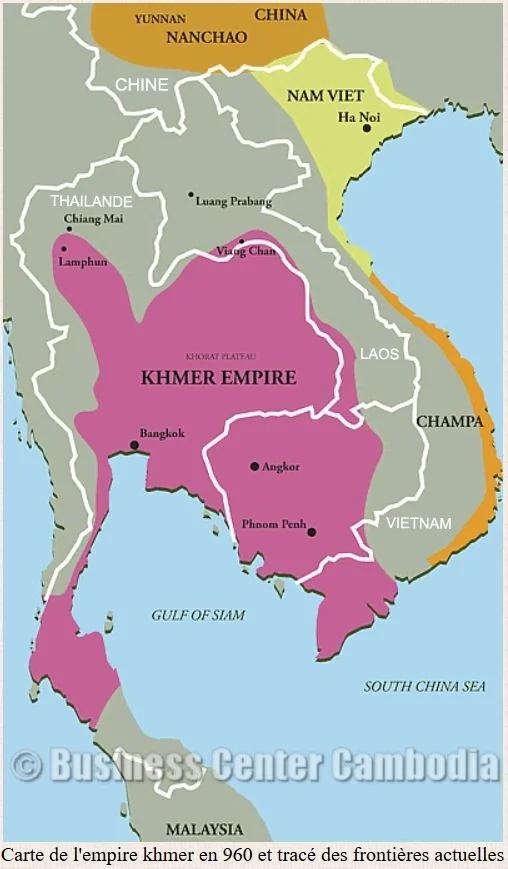
Map of the Khmer Empire in the Year 960
With the current borders marked
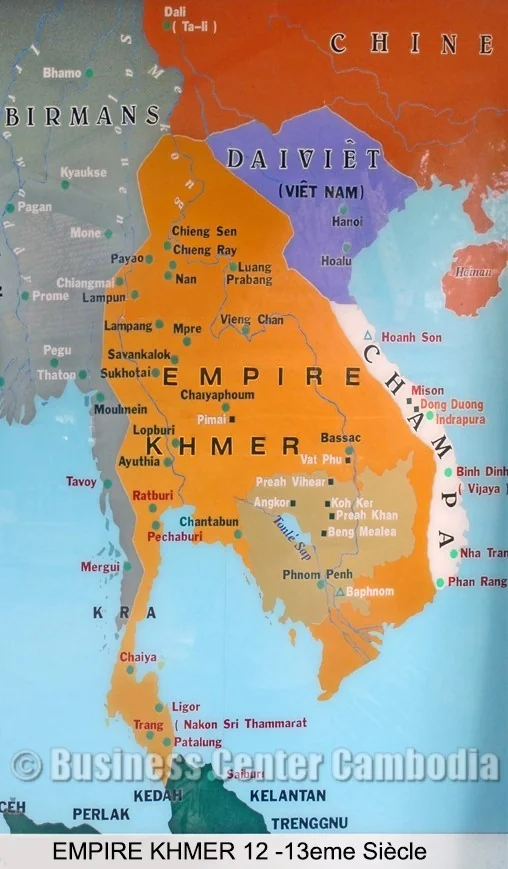
The Khmer Empire (12th - 13th Century)
At its peak during the 12th and 13th centuries, the Khmer Empire extended into present-day:
- Vietnam
- Thailand
- Laos
- Southern China
It was one of the most powerful civilizations in Southeast Asian history.
Flags and Coats of Arms of Cambodia through History
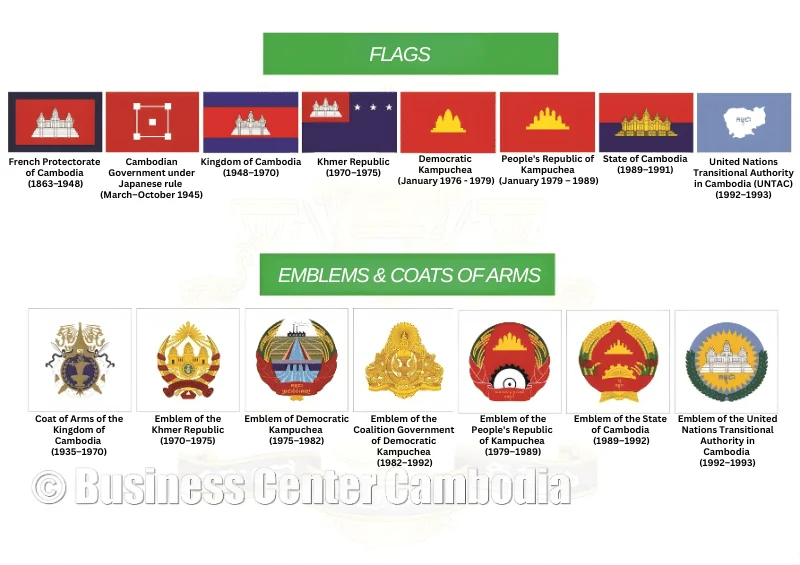
Cambodian National Symbols
The Cambodian Coat of Arms
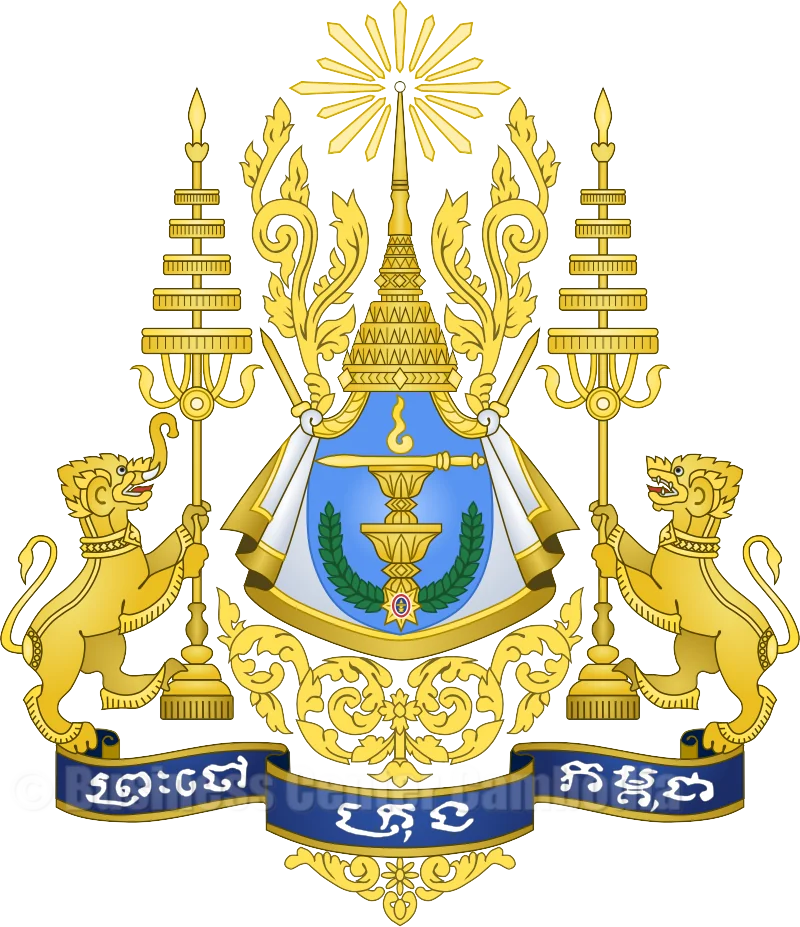
The royal coat of arms was officially reinstated in 1993 after the restoration of the monarchy.
It features:
- Two mythical creatures:
- On the right: a Gajasimha (a lion with an elephant’s trunk)
- On the left: a Singha (mythical lion)
- Each holds a five-tiered royal parasol
- The national motto in Khmer: “Preah Chau Krong Kampuchea” - King of the Kingdom of Cambodia
The National Flag of Cambodia
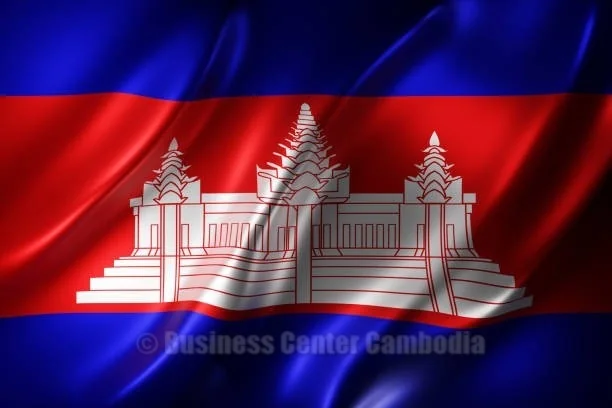
Known in Khmer as “Tung Cheat”, the Cambodian flag consists of:
- A central red horizontal band
- Two blue bands at the top and bottom
- A white depiction of Angkor Wat at the center
Symbolism:
- Blue → Royalty
- Red → The Nation
- White → Religion (primarily Buddhism)
The flag was first introduced in 1863, the year Cambodia became a French protectorate.
Roads and Railways Are Rapidly Evolving
Infrastructure development remains a top government priority.
Key goals include:
- Expansion of the road network
- Development of railways
- Construction of new ports and airports
Cambodia is estimated to require USD 1.2 billion per year in infrastructure investment to modernize the country.
Recent developments:
- 2016: Passenger trains resume service between Phnom Penh and the coast after 15 years of interruption
- 2018: A new rail line connects Phnom Penh to the Thai border
- After Covid, the northern railway line currently operates between Phnom Penh and Battambang
- New locomotives and passenger wagons have entered service
Economy and GDP of Cambodia
Cambodia’s GDP growth has averaged around 7% per year over the past decade (before COVID and approximately 6% in 2024). The country stands among the most dynamic economies within ASEAN.
This stable growth has been driven mainly by the expansion of agriculture and tourism.
Although GDP per capita remains one of the lowest in the ASEAN region, it is important to highlight that it has tripled over the past decade.
The Asian Development Bank (ADB) reports that the percentage of Cambodians living below the poverty line has fallen from 50% to 20% over the last 20 years.
Economic Outlook
- 2021: These figures were significantly affected by the pandemic, with growth estimated at around 4%. During this slowdown, Cambodia took advantage of the absence of international tourism to accelerate major infrastructure projects, particularly in road networks and the construction or renovation of airports.
- 2024: The Asian Development Bank projected growth of approximately 6%, a target that was nearly reached.
- 2025: The situation remains stable with an estimated growth rate of 5.5%.
Pillars of the Cambodian Economy
The Rise of the Construction and Real Estate Sector
Four main sectors are considered the pillars of Cambodia’s economy:
- Textile and garment industry, representing one-third of GDP and 80% of national exports
- Agriculture, which still accounts for about one-third of GDP
- Tourism
- Construction and real estate sector
The number of tourists doubled between 2010 and 2015. Cambodia had planned to welcome nearly 7 million visitors by 2020 and close to 10 million by 2025. This industry was expected to generate USD 5 billion in revenue by 2020 and create nearly 1 million jobs for Cambodians. Tourism thus became a major driver of economic and social development. However, the pandemic delayed these projections.
At the same time, there has been a strong rise in construction and real estate activity, driven by a significant influx of Chinese, Japanese, and Korean investors.
Statement from Cendy Lacroix About Cambodia
In an era of conflict, where creative stagnation supported by an overwhelming tax system seems to be the only visible future offered by France,
relocating to Cambodia appears to be a real and valuable alternative.
Here, the words FREEDOM and ENTREPRENEURSHIP are not considered acts of defiance.
Personal fulfillment can once again find its place in your life.
Be careful, Cambodia is not always easy, but its challenges are simpler in nature.
Written in January 2019 and still relevant in 2025.
On this page, Cambodia has been mainly presented from an economic perspective. Aspects such as quality of life, the kindness of the Cambodian people, and the beauty of the landscapes have not been addressed here.