
Why Expats Are Leaving Sihanoukville
Chinese investments, rising costs, and the transformation of daily life in Sihanoukville
Sihanoukville? Did You Say “China-noukville”?
The topic is launched! Dozens of “Western” expatriate families are leaving Sihanoukville or rather, fleeing Sihanoukville.
Whether they are French, Italian, English, Australian… no nationality is spared.
No matter how many years they had settled in this lovely and authentic Cambodian seaside town, whether they came for a peaceful retirement or to invest, they are leaving the city…
Business Center Cambodia Note:
This article is written strictly from the perspective of the impact on business and daily life in Sihanoukville.
There is absolutely no hostility toward the people of the Middle Kingdom, for whom we have the greatest respect.
A Few Years Ago
This Topic Was Written In July 2017
What Is Happening?
The phenomenon is very simple: it is called “Chinese investors”!!!
In just one year, they took over 70% of the city.
They buy everything!
Buildings, hotels, restaurants, shops, land, houses, factories, premises…
From luxury apartments to rundown rooms, from small Khmer canteens to 4-star hotels. They take everything!
Their unbeatable negotiation argument: THE DOLLAR. THEY BUY EVERYTHING AT THREE TIMES THE PRICE.
Tourism being a major source of income for the country, the government multiplied efforts to promote this beautiful nation. However, to welcome this demanding and massive Chinese clientele, suitable infrastructure was required, hence the massive arrival of Chinese investors and workforce in Sihanoukville.
“Cambodia recorded around 900,000 Chinese tourist arrivals in 2016 and hopes to attract 1 million this year and 2 million by 2020…” (May 2017)
Articles Published In The Press
“We must target the Chinese, and to increase the number of tourists from China, Prime Minister Hun Sen encouraged Beijing to open consular representations in Cambodia’s tourist areas. The Prime Minister also expressed his wish to see the use of the Chinese currency become more widespread…”
March 2016 - Extract from Cambodia Mag“As part of ASEAN-China tourism cooperation 2017, Cambodia wishes to welcome one million Chinese tourists this year. Given the 390,000 Chinese tourists welcomed during the first four months of the year, a 30% increase compared to 2016 over the same period, Cambodia seems well on track to achieve its challenge. The final goal is to welcome two million tourists by 2020. Each week, 150 flights from China to Cambodia are scheduled through 12 different Chinese airlines.”
Asiaconnection Article
If the objective of welcoming 2 million Chinese tourists already seems almost achieved,
we are not even talking about the figures concerning Chinese residents who will settle permanently in Cambodia…
Chinese Tourism: Why Such An Enthusiasm For This City?

The sun? The beach? Khmer culture? Of course not!
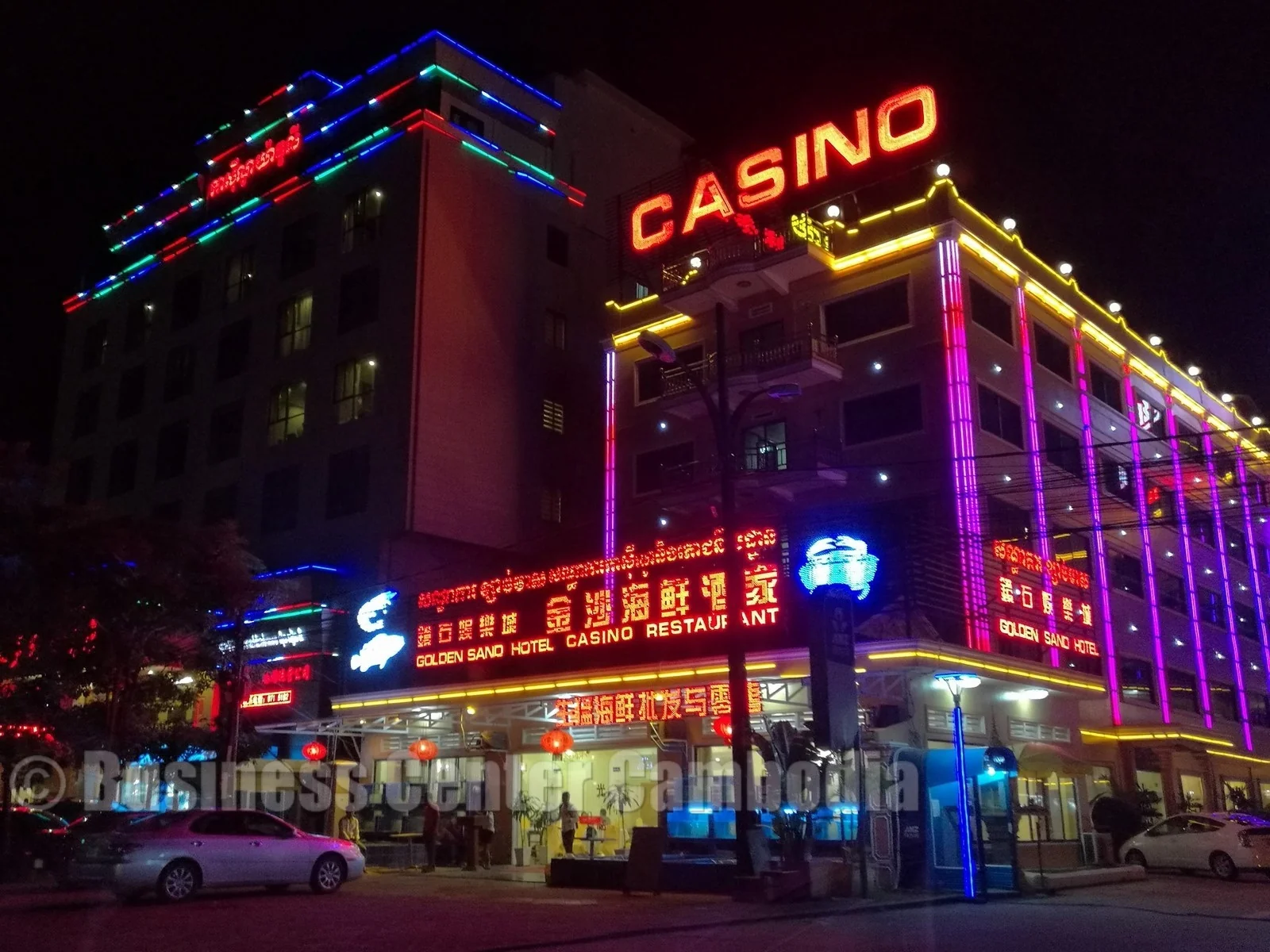
THEY COME FOR GAMBLING. “LITTLE MACAU” IS ON THE WAY.
While Macau has 32 casinos, **Sihanoukville has just as many*** and more are under construction…
Some display bright signs with names or logos that leave no doubt about their activity, others are much more discreet, known as “private,” sometimes hidden in hotel lobbies behind large black curtains…
Some of these venues are STRICTLY RESERVED FOR CHINESE CLIENTS.
There are areas where the yuan and the US dollar get along very well…
Why So Many Casinos In Sihanoukville?
In most Asian countries, casinos are either forbidden or reserved for foreigners, as Asians are known to be very fond of gambling and can easily ruin themselves.
The current government policy encouraging investment in the Kingdom, the ease of settling, and the low tax conditions have attracted these new investors.
By organizing “tourist trips,” Cambodia becomes attractive for gambling just as much as for visiting temples…
* This figure was accurate at the time this article was written in July 2017.
In August 2018, there were already 70 casinos, and some sources mentioned that there could be nearly 100 by the end of 2018.
2019: There are now approximately one hundred casinos.
Housing: What Impact?
In Cambodia, everything is simple… until it suddenly becomes complicated. Today, if you are considered a “Westerner,” it is increasingly common to be refused the rental of an apartment, or even a hotel room with the explanation: “NO, RESERVED FOR CHINESE.” Sometimes this refusal even comes from a Chinese person who, with a casual wave of the hand, will ask you to leave, as the vast majority of Chinese residents in Sihanoukville speak only Chinese.
They do not rent a single apartment; they rent the entire building. They do not request a hotel room; they rent the whole hotel. The same applies to residential housing complexes. As a result, Khmer property owners are thriving. They do not hesitate to ask tenants to leave, sometimes with as little as one week’s notice because the entire building or residence has been rented out to Chinese tenants.
This is where the real struggle begins. Even in urgent situations, after lowering your expectations, you will still face many refusals with the same response: “No, it is rented to Chinese.”
This situation affects not only expatriates but also the Khmer population.
Business: What Impact?
A commercial property that rented for USD 3,500 per month three years ago (in 2014) now rents for at least USD 8,000 per month!!!
Here again, problems are multiplying. Many expatriate entrepreneurs are being “pushed out” of their businesses. It only takes a weak initial lease contract for a landlord to evict you without compensation. Sometimes using questionable arguments to justify an alleged breach of contract and with very short notice to vacate the premises.
Time is critical, as the property is often re-rented immediately at a much higher price (your own investments helping to justify the new value) to a Chinese company or individual, usually with a minimum one-year rent deposit, or even several years conditions that the new tenant readily accepts.
Is There Any Legal Recourse?
If your lease did not include a clause providing for termination by the owner with compensation equal to “X” times the deposit, or reimbursement of the investment costs plus penalties, then unfortunately, no, you can say goodbye to your investments and try to find another location as quickly as possible.
And once again, this will not be easy anymore.
Business Center Cambodia Note:
For those who signed “light” lease contracts a few years ago (2 or 3 pages at the time, if that), this sharp increase in rental prices and the resulting change in landlords’ ambitions was completely unpredictable.
Today, lease contracts include far more protective clauses often around 12 pages to better safeguard investors.
For entrepreneurs who had a solid lease contract drafted from the beginning, there are still frequent attempts by real estate agencies or landlords to break the agreement. Business Center Cambodia has already intervened in several cases where our offices had drafted the original lease contracts. In these situations, there is absolutely no legal possibility for these investors to be forced out unless the proposed compensation is satisfactory and accepted by our client.
Otherwise, the landlord must patiently wait until the end of the lease term.
Sales Blockage Scenario
Another situation can arise when the current tenant wishes to “resell” meaning transfer the remaining lease, investments made, business turnover, etc. (similar to what would be called a “business goodwill,” even though this concept does not officially exist in Cambodia).
It may happen that a buyer is found, but during negotiations between the new tenant and the landlord, the landlord suddenly announces a rental price two to three times higher than the current rent.
This situation effectively blocks the sale even if a clause allowing this transfer was included in the original lease. We strongly advise contacting the landlord beforehand to inform them of your intention to sell and to clarify their new conditions.
If you are planning to settle in Sihanoukville soon… see “Sihanoukville: Our Opinion.”
Daily Life And Atmosphere: What Is The Climate Like?

We could rejoice that these new investors are taking an interest in the city and contributing to its development primarily for its people and the local economy. Unfortunately, this is not entirely the current picture, except perhaps in terms of tax revenue. Many local Khmer families are also being displaced and are struggling to find housing at reasonable prices.
The Western clientele has become far less significant, largely replaced by Chinese customers who rarely speak English. In hotels catering to this clientele, local workers are being replaced by Chinese employees. Tuk-tuk drivers also have far fewer customers. However, many jobs are still being created due to the large number of new establishments.
This new clientele consumes differently and mixes very little with the local population. They eat Chinese food, buy Chinese products, move around in groups via minibuses, stay in Chinese-owned hotels, and gamble mainly in Chinese casinos. They also have behavioral codes that are quite different from what Westerners are used to noise in shops and especially in residential buildings if you have Chinese neighbors, as well as the invasion of orange life jackets in swimming pools at sunset.
All of this is now part of the new landscape of Sihanoukville.
In factories too, which are becoming more and more numerous, locals can still find work fairly easily.
"China plans to create a total of 300 factories in the Sihanoukville Special Economic Zone, generating approximately 100,000 additional jobs." November 2016, Cambodia Mag.
Tensions sometimes arise between local residents and these new arrivals. The local Khmer population is worried about soaring prices, the growing difficulty of finding housing, and the loss of jobs, which they attribute to this new and highly visible population. Cases of incivility involving Chinese nationals have multiplied in recent months.
In July 2017, the press reported a fight involving Khmer and Chinese individuals in downtown Sihanoukville. Read the article. Another incident in May 2017 involved clashes between rival Chinese gangs in the city center. Read the article. The media also frequently reports the dismantling of Chinese online gambling networks (read the article) as well as various scam operations. Read the article
What Happens To These Expatriates From Sihanoukville?
The situation is not entirely bleak!
Fortunately, some expatriates are living through these changes very well.
Either by adapting their products to a more Asian clientele, or on the contrary by emphasizing their “Western” appeal. These ones still enjoy this small seaside town just as much, and they can even benefit from the exponential increase in the value of their businesses.
And for those who enjoy vibrant, bustling cities, Sihanoukville remains a true source of inspiration.
For others, some have relocated to another city, while others have left the country altogether.
Many expatriates have chosen calmer Cambodian cities. Kampot is particularly popular with its river and colorful colonial architecture, as well as Kep, the small family-friendly seaside resort, and Battambang.
Following numerous discussions on this topic with people of different nationalities, the conclusion is unanimous: never before have so many Westerners left the country in such a short period of time and these departures concern expatriates who were settled in various Cambodian cities.
What is most surprising is that these are not recently arrived expatriates. On the contrary, most of them have around 10 years of experience living in Cambodia, or even more.
It would be wrong to attribute this solely to the massive arrival of the Chinese population. Other factors are also involved, such as the tightening of laws, significant tax increases, and growing administrative obligations.
Then there is also the changing landscape: cranes announcing high-rise towers, small paths turning into congested avenues crowded with large vehicles…
Still, there remain beautiful places in Cambodia where harmony with the warm and smiling people continues to promise a pleasant way of life.
Sihanoukville: Our Opinion
Are you planning to settle in Sihanoukville soon?
Then, follow one essential rule at Business Center Cambodia:
“Nothing is more valuable than your own personal feeling.”
If you already know Sihanoukville and have visited it again in recent months, take the time to rediscover the city.
The changes may seem far more radical, or far less than what this article describes…
“Unless you are deeply fond of and immersed in Chinese culture,
unless you speak at least one of its languages or dialects,
unless chopsticks feel like a natural extension of your fingers,
unless you have a perfect understanding of Chinese consumer habits,
or unless your project is already very popular in Beijing,
it will be essential to carefully assess whether your project is viable before settling there especially if you were planning to open a Breton crêperie.”
Always keep in mind that your product must be adapted to an existing or emerging clientele.
In this specific case, one could say that “the game is already played” no pun intended.
After carrying out your own analysis, if the environment suits you, seek professional assistance for verifications, negotiations, and above all, THE DRAFTING OF LEGAL DOCUMENTS.
Opportunities in Sihanoukville: See Opportunities in Cambodia (members-only page).
The Word From Business Center Cambodia
We do not take a “for or against” position regarding the new direction Sihanoukville is taking.
We ourselves and part of our team are expatriates, or immigrants if we use the proper term.
It would therefore be inappropriate for us to hold a negative opinion about the arrival of another nationality.
What concerns us most is not only the future of these expatriates who sometimes leave this city with sadness (for some), although many Western expatriates still enjoy living there and continue to thrive.
We know how adaptable expatriates can be, and changing cities is not an insurmountable challenge.
Our main concern is whether this new wave of expatriates will bring added value to the Khmer population through training, opportunities to learn new languages, and prospects for future growth and development.
Two years ago, we announced to future settlers that the city would become a blend of Saint-Tropez and Macau and we were right.
For several months now, we have also turned our attention to other very promising cities, where many viable and highly anticipated projects are waiting to emerge. We have opened new markets and expanded our activities beyond national borders.
Following serious studies conducted with partners who have expert knowledge of different markets, and in light of upcoming development projects, we have jointly developed a new catalog of opportunities, businesses, and personal relocation projects:
private islands, sea-view land, luxury coastal homes, colonial houses to renovate, real estate projects, hotels, retail, healthcare, tourism, craftsmanship…
We are now able to offer you turnkey projects.